
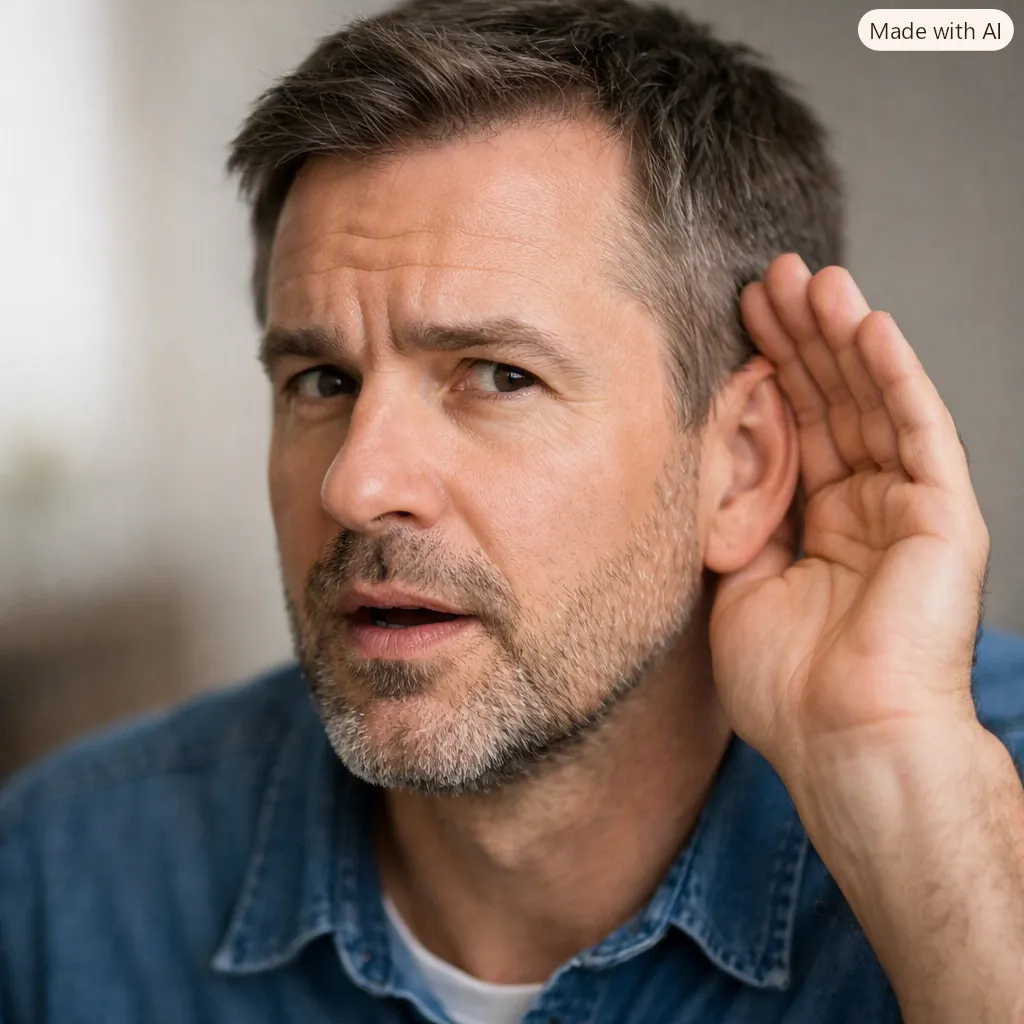
Hearing loss has taught me many things about speech and communication. I’ve gained an appreciation of the value of projecting one’s voice; of speaking clearly, slowly, in complete sentences while making eye contact with another person. I have let go of the pleasure of witty repartee and of the expectation that one can have meaningful communication in noisy or crowded situations.
“Hear” are some of the observations I’ve made while coping with hearing loss:
1. Hearing is different than understanding. The spoken word consists of sounds, but the meaning of those sounds is what is important. Understanding is not necessarily a matter of the loudness of a person’s voice. It also includes the clarity of thought that is transferred to speech, enunciation, sentence structure, and context. One who speaks a language that is foreign to the listener may be loud enough to be heard but the listener may have no clue as to their meaning if he doesn’t speak that language.
2. What we see or hear is partly determined by what we expect to see and hear. As hearing loss grows the brain begins to fill in the gaps with what it expects is being said. The result can be a minor misunderstanding; an amusing one; or, a disaster.
3. It is not necessarily difficult to understand a person who stands in front of you; who makes eye contact with you and who speaks intentionally with something to say. However, like the big trucks that carry a sign “If you can’t see my mirror, I can’t see you,” if I cannot see your eyes, my hearing loss may eviscerate my understanding of your words.
4. Many sounds, consonants, and vowels are soft and difficult to distinguish. Enunciation with patterned speech (rather than monotone speech pattern) can make a significant difference.
5. Names and pronouns are a deadly mix when more than one person is being referenced. Best to use the name of the person or object and avoid or limit the use of pronouns. With society moving towards pronouns like “they” instead of “he” or “she” it becomes even more difficult to link the name to the pronoun.
6. Hearing loss impacts cognitive understanding, partly, I suppose because the strain to hear triggers tension or frustration which interferes with and worsens comprehension. (It is true, but easier said than done, that calm, sensitive listening enhances understanding.)
7. Beginning a conversation, or a new topic in a conversation, with the KEY WORD of the topic such as the name of the person, place, or object to be discussed is to risk leaving your listener in the dust of wondering who or what you are now suddenly talking about. The brain needs a moment to adjust to the introduction of a new topic. An easy solution is to give an introductory phrase or sentence to signal a change in topic. Examples of introductory phrases to introduce a new subject or change the subject can be throw-away phrases such as: “By the way, I wanted to mention something about so-and-so.” Or: “On different topic, I was thinking about XXXXX.” Thus, the KEY word isn’t stated FIRST in your sentence when your listener has no reason to expect it.
8. The English language is structured loosely but generally follows the pattern of subject-verb-object. Throw in an adverb or an adjective now and then and we’re ok. But some speakers speak before they think, “so-to-speak,” and their sentences are all a jumble of words. While this can reflect incoherent brain patterns in the speaker, the result for a listener with hearing loss can be very disjointed. Frequent insertion of parenthetical thoughts on unrelated topics makes things worse. Speaking slowly and clearly (one thought at a time) allows for communication to be satisfying to both parties. Some people don’t use complete sentences at all, but tend to “bark,” “chirp,” or “blurt out” sounds or phrases. This pattern is more deeply embedded in people’s brain, chemistry, breath, and habits and is much more difficult to change. ADHD sufferers would be good examples of folks whose words just come tumbling out in all directions. There’s no easy fix to this but, just to acknowledge the reality, there are people whose conversation I simply cannot follow even when I hear their words.
9. In a car, most of us speak facing forward and not necessarily turning to the other person. Given the loud noise of the street, engine and outside sounds, car conversations are difficult if the speech is directed to the window or the back of the front seat. Being confined to the back seat all but guarantees no participation in conversations from the front seat.
10. Fortunately, very few people turn their backs on their listeners and continue speaking as they walk away. But I have known one or two friends who have the habit of doing this: as they walk away from you, they continue talking! This is neither polite nor effective.
11. Some people are “all ears” and hear, whether they want to or not, the conversations going on around them. But others pay no attention and those with hearing loss usually have no choice in the matter. Calling someone by name may or may not get their attention if they’ve trained their brains to ignore general speech around them. If you wish to speak to me, first get my attention by addressing me by name and to my face, thus indicating a desire to speak to me!
12. I never realized until dealing with hearing loss how many ventriloquists exist in the world: people who speak without moving their lips or without any air passing through them! I don’t know how they can be so unaware or not notice how often others ask them either to speak up or repeat themselves. Some people are, I assume, simply shy; others may be unsure of themselves and even lack confidence in their own statements. Some may be accustomed to talking out loud to themselves without regard to whether anyone else hears or cares. Are you one such person?
13. Some cultures and some people speak very fast. Other languages or individuals add or drop vowels or consonants from words. Italians add an ‘a’ to the end of words while some Hindi or other speakers drop the ‘a’ at the end. (“Yoga” is sometimes written and pronounced in India as simply “yog.”). For clarity of speech, adding a sound is better than dropping one.
14. Swami Kriyananda (my teacher) pointed out the tendency of speakers to drop the pitch and volume of words at the end of either the sentence or the word. Perhaps because they’ve run out of breath or energy, and they “swallow” the last word. A solution to this common tendency is to raise the pitch at the end. It makes for more interesting and clear communication. (This is related to diaphragmatic breathing, keeping the chest up and like trained singers, speaking consciously.)
15. I like to joke that I can eat, talk, or listen but I can only do one of these at a time. So, when sharing a meal, I either need to chew, listen to you, or speak but only one of these at a time!
16. Monotone speakers are either dull or maybe just sound dull as if slightly drugged. Without some variation in emphasis, for example emphasizing a key word like a person’s name, such speakers risk being ignored. Like Italians famous for talking with their hands, some liveliness, color, and modulation in speech is both effective and interesting.
17. Suffice to say, I must walk a line between saying “What” so frequently that I might be mistaken for a parrot; or, simply staying out of many conversations and miss valuable sharing. There are numerous conversations I refrain from entering or I just simply smile and nod or offer some monosyllabic utterance to indicate that I’m still conscious. I have all too frequently listened to someone speaking and not even had a clue what they were talking about. Sad, but true.
18. Despite both their expense and sophistication, hearing aids, while essential for many of us, can NEVER substitute for natural and efficient hearing.
19. Captions are a great gift to humanity! There are movies out there whose directors seem to specialize in hiring ventriloquists. My phone now has captioning: yeah!
20. It is simply amazing to me that humans EVER understand each other. It seems that communication is like a game of chance, or to misquote Forrest, Forrest Gump, like a box of chocolates (“You never know what you’re gonna’ hear.”).
Thank you for “listening” even though I have no expectations as to this changing the conversations I encounter.
My favorite chant these days is “Listen, listen, listen” by Paramhansa Yogananda.
Nayaswami Hriman
Ananda WA - first written 2015!