
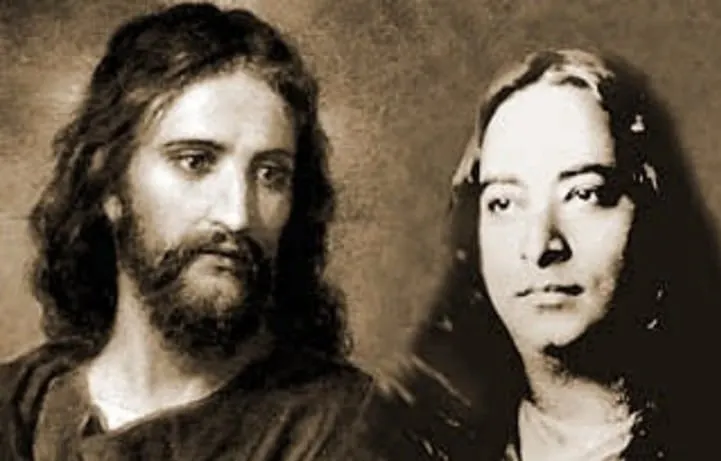
The Dice (of Life) are Loaded!
“For God so loved the world, that he gave his only begotten Son, that whosoever believeth in him should not perish, but have everlasting life.”
John 3:16
This quote comes from a nighttime conversation with Jesus by a man called Nicodemus. Nicodemus was a scholarly Pharisee and a member of the ruling council in Jerusalem called the Sanhedrin. He came at night because he didn’t want to be seen with Jesus during the day but he was very drawn to get to know Jesus and his teachings.
Naturally this quote seems to be a reference to Jesus himself being sent into the world. But there is a deeper meaning revealed by Paramhansa Yogananda. And it fits into the conversation with Nicodemus because Nicodemus came seeking the deeper teachings. Jesus didn’t identify himself, personally, in that quote. He used the phrase “only begotten Son.”
Jesus, like other great teachers called avatars, have realized their oneness with God. This achievement is the destiny of all souls through time and space when at last the soul makes the choice to seek freedom in God. For Jesus the use of the personal pronoun “I” has a much deeper meaning and context than Jesus a man who lived in time and space.
God’s presence in the world, Yogananda taught, is manifested in two ways: first, in the innate, indwelling silent intelligent bliss of the soul. This presence has many names but Yogananda mostly used the term Christ-Consciousness (or, at times, Krishna consciousness). The second, is the Holy Spirit, the primordial, vibration out of which all forms appear and are sustained (and withdrawn). This Holy Spirit is viewed as feminine in India and is depicted in the various forms of the goddesses. Viewed impersonally as the foundation of the creation itself, It is the “Amen,” the “Aum,” the “Amin” chanted by devotees around the world. In the form of Jesus the man who had achieved complete identity with God’s immanent presence in creation, It is the “Word” that was made flesh and dwelt amongst us.
In manifesting the universe it was essential that distinguishable objects, energies, thoughts and feelings be created. God, being ONE, had to separate thought from feeling, idea from form, subjective from objective. It is in this projection from God who is One and beyond creation into manifesting the infinity of diverse forms in creation that is the primordial act of love of God sending his offspring, his consciousness, or son, both into and as the world: having as it were two distinguishable manifestations.
This expression of God’s love, His love being the primordial intention and feeling is the macrocosm of creation. Jesus had achieved union with both the indwelling consciousness and the creation itself in addition to union with God beyond creation, in short the Trinity, in a prior incarnation.
The creation is itself an act of love: God seeking to share His love with all; God giving to us the freedom to love or reject Him. His love is literally the heart of all created things and Beings. God’s love is unconditional for it demands nothing in return and gives us the freedom to return or to reject that love. We see in human that a man and woman uniting in love create another human being. Love is the intention, the impulse that creates.
All of this philosophy is a complex way of saying THE DICE ARE LOADED. God gives to each soul the choice to choose freedom or to remain seeking fulfillment in the creation. In a meaningful way, however, the dice are loaded toward seeking God because there is no other reality to be found. God IS the creation; God IS the intelligent perception with which we view it; God IS the feeling we have of our own existence and, by extension, God is the identifications, attachments, and emotions we project upon the world around us. It’s not that we don’t have the choice but at some point we have the realization that there is a better choice! We realize that there is a way out of disappointment, boredom, endless change and the existential suffering inherent in our separation from life and from God.
About once or twice a year I visit a prison south of Aberdeen along the southern coast of WA. I have several inmates there that I correspond with by email, phone and video. I was invited to be a “visitor” to an annual religious event sponsored by a local Zen Buddhist teacher. Each recognized faith tradition is allowed to do this but the WA Department of Corrections doesn’t (yet) recognize Self-realization as a separate faith. As an approved visitor I am not allowed to also have the role of an outside religious teacher or minister. But a friend of ours, a fellow Nayaswami, lives in Elma not far from the prison and he has submitted a proposal to offer a six week meditation class to get something started. Later perhaps we can file for separate religious recognition.
Speaking of the “dice are loaded” it was inspiring to see that among the 50 or so inmates who applied to attend the Zen Buddhist program, there were many who are very sincere. Sometimes the extremes of life make the choices we have very clear. I suppose this is one reason it is difficult to advance spiritually after death in the astral world where, for a person of goodness, it’s like going on vacation to Hawaii. We need the contrast to help us to see the consequences of our choices and to have the incentive to make a disciplined effort. “There but for the grace of God go I”
Consistently throughout the Old Testament of the Christian Bible you see the prophets giving dire warnings to the Israelites against their faithlessness. And yet in each case, the prophet also gives the hope, promise and means of redemption. No matter how far the Israelites, meaning you and me, fall, mercy and the way out is also extended to us.
This promise is repeatedly given also in the gospel of Luke, as, for example in the story of the Prodigal Son; and, the story of the lost sheep; even the story of a lost coin.
Here’s the thing though. We have the choice. As the commentaries on Sankha Darsana aver, God cannot be proved. Only intuited.
Thus most people on the planet in this age of Energy and Self-interest (Dvapara Yuga) are busy with making money, gaining status, finding satisfaction or self-improvement. The realization of the divine presence comes only to those whose souls have awakened to a certain point.
This is the function of the sat guru, the savior, the avatar. Yet even the saints and lesser teachers, too, serve the role of pointing a finger to the moon: the “moon of my delight who knowest no wane: the soul.” (Quatrain 74 of the Rubaiyat of Omar Khayyam)
Most people are so busy with sense impressions of sight, sound, etc and thoughts, emotions, imagination, and memories that they don’t notice that all of these things are invisible. They are mental impressions, images and silent words in our minds; and, importantly, our response to them!
This is why mindfulness is the beginning of our awakening. We begin to realize that the world is in our head, not objectively, but subjectively. Our world revolves primarily around what we think and feel. Of course outward circumstances play a part, yes, but mostly their impact depends on our mental and emotional response to them.
This is the very definition of our soul’s freedom: “yogas chitta vritti nirodha.” Yoga is the neutralization of the reactive waves of likes and dislikes.”
This invisible world is the gateway to world of Spirit. In the next higher age (4000 AD or so), the third age called Treta, humanity at large will gain awareness of the invisible world of conscious energies and Beings whose influence and magnetism dictate more than anything else our experience of life. For now, however, we are not generally there.
For us, we need to develop our will power, refine our devotion even if we only dimly perceive God, the gurus or saints; we need to craft our self-discipline using the tools of yoga. These tools are the four paths of yoga: action, thought, feeling and meditation. These paths are not limited to those practicing yoga but are for all people in all faith traditions. (For others, prayer is the substitute for what we call meditation. Deep prayer leads naturally to meditation.)
For us in this age, our invisible influences are incarnate in the form of our friends and fellow truth-seekers. These are what guide us the most. This is why having fellowship, a church, an ashram, a community is so important. Paramhansa Yogananda said that our “environment is stronger than will.” As our mothers noticed when we were in grade school, the kids we hung out with were a greater influence on our behavior than parents or teachers.
This is where today’s affirmation on calmness fits in. The path to God begins with awareness and awareness flourishes in the ocean of calmness. With calmness the fog of mental distraction lifts and reveals the sunshine of God’s presence. This is why meditation holds the central place on the path of Self-realization.
As we are fond of quoting our founder and teacher, Swami Kriyananda, “It’s not WHAT you do, it’s HOW you do it.” Meaning the awareness and calmness and intention behind your actions, your thoughts and feelings is what counts. This is what is meant when Jesus said “Then shall two be in the field; the one shall be taken, and the other left.” (Matt 24:40). Two people can do the exact same task, even two ministers of the Lord, but one will be uplifted into grace while the other merely goes through the motions.
This too is the source for Jesus’ inexplicable remark that “the poor ye shall have always with you but not me.” It is true communion, awareness of the Spirit within us, awareness of the touch of transcendence, that we seek. It is not common and should be sought with calm even mindedness, expected with the joy of the soul, and cherished in our heart. Jesus of course taught and touched the poor, so his remark has to be understood in its proper context.
When the soul has “ears to hear” and “eyes to see” the invisible world of Spirit, the guru-savior comes to stimulate that memory and inflame our resolution to seek the “pearl of great price.” When that Christ-child is born in the humble manger of our hearts, he sends the Holy Spirit, the intelligent energy of Divine Mother, to re-arrange circumstances to support our resolution.
I am reminded of the strange story of Sasi, a college friend of Yogananda’s who spent weekends at Master’s ashram. Sri Yukteswar warned the young man that his life was disorderly and wild and that unless he reformed he would be dangerously ill. Sri Yukteswar encouraged Sasi to wear a gemstone bracelet but Sasi objected saying he had no money and he preferred to depend on Sri Yukteswar’s grace! Swami Sri Yukteswar predicted that in one year hence Sasi would bring to him three sapphires but it would be too late.
Sure enough a year later, Sasi was ill to the point of death; and, as predicted, he came desperately to Swami Sri Yukteswar with three sapphires. Swami Sri Yukteswar informed Sasi that the gemstones were of no use. Swami Sri Yukteswar entered into meditation and when finished Swami Sri Yukteswar told Sasi to wear an astrological bangle and in a few weeks would be well.
In a few weeks Sasi was on his deathbed agsin but despite Yogananda’s concerns and listening to Swami Sri Yukteswar’s original reassurance, Sasi suddenly recovered having felt Swami Sri Yukteswar’s presence. Sadly, Sasi ceased to did not continue his relationship with Swami Sri Yukteswar. Surely Swami Sri Yukteswar knew that in advance but felt the guidance to respond to Sasi’ s unfailing faith and thus cured the boy that he would live a full life notwithstanding his absence.
THE DICE ARE LOADED. This is the gospel, the good news. Rejoice. To even WANT to be free means your soul has awakened and the time for knowing God has come to you!